Data Quality Monitoring Pattern
A synthetic analytics case study for turning scattered data checks into prioritized, traceable, and operationally useful quality signals.
- SQL
- Data Quality
- Data Warehousing
- Tableau
- Root-Cause Analysis
Overview
This privacy-safe case study models a recurring analytics problem: data issues are discovered in reports, but checks are scattered across queries and team knowledge. Failures are difficult to prioritize, and a red indicator rarely explains who owns the next action.
The proposed monitoring pattern uses synthetic entities and generalized rules. It demonstrates the analytical method without exposing client data, internal systems, or proprietary thresholds.
The problem
Traditional quality reporting often counts failed rows but leaves operational questions unanswered:
- Is the issue new, persistent, or already recovering?
- How much business activity is affected?
- Did the source stop arriving, or did a transformation change the result?
- Which team owns investigation?
- Can a user see representative failures without accessing unnecessary sensitive data?
Quality model
Each rule is defined as metadata rather than an isolated chart. A useful rule records its business purpose, dimension of quality, expected threshold, severity, data owner, technical owner, evaluation grain, schedule, and safe diagnostic fields.
The initial dimensions are intentionally understandable:
- Completeness: required values or expected records are present.
- Validity: values conform to permitted formats, domains, or ranges.
- Uniqueness: business keys do not appear more often than expected.
- Consistency: related fields and systems agree under documented rules.
- Timeliness: data arrives and refreshes within its operating expectation.
Monitoring flow
Prioritization
A useful severity model separates rule failure from business impact. Priority can combine the criticality of the affected data product, failure rate, affected volume, persistence, and whether the condition blocks a downstream decision.
That distinction prevents a large but harmless formatting issue from obscuring a small population of materially incorrect records.
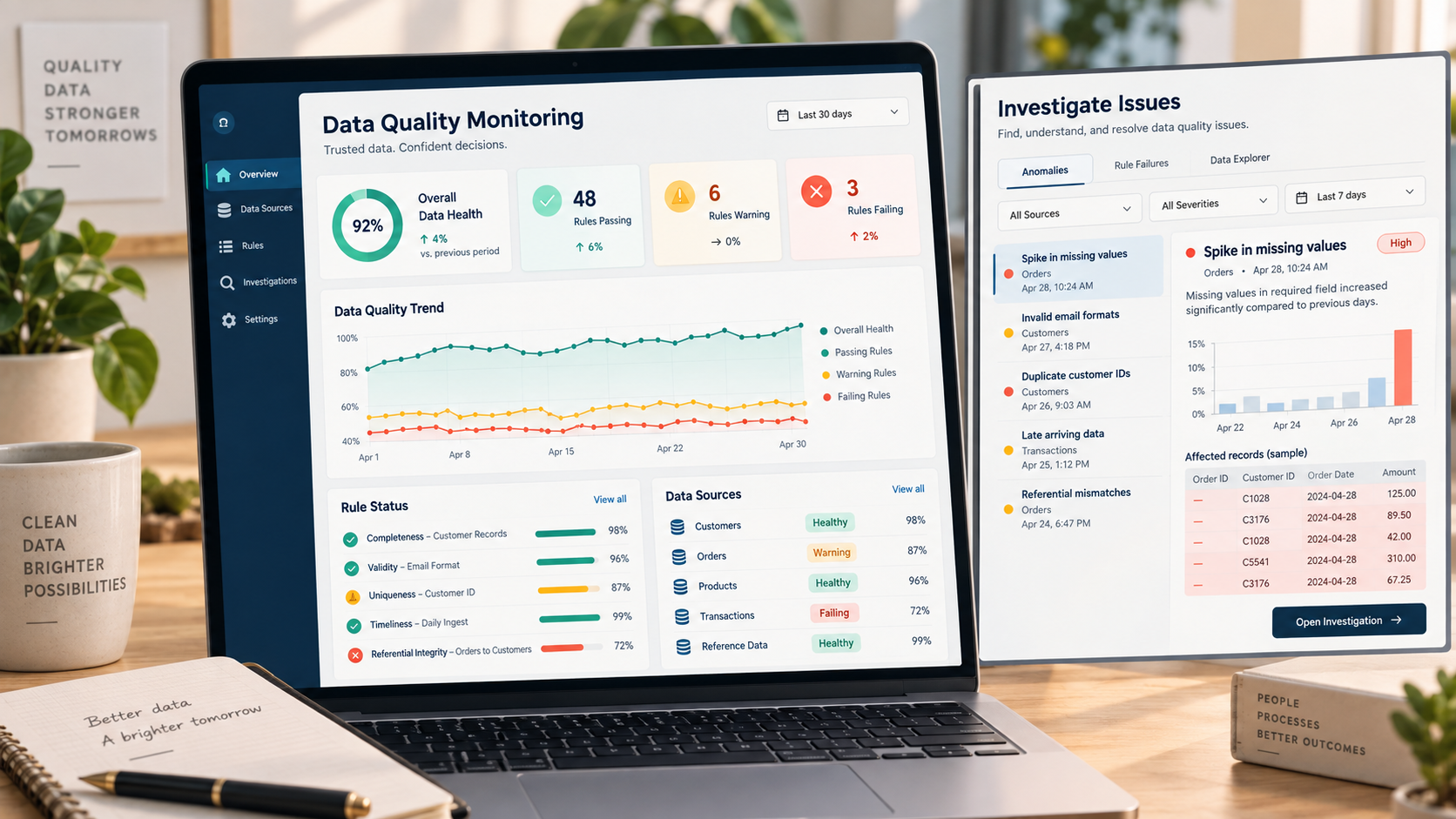
Investigation experience
The summary view should show health by domain, recent change, persistent failures, and freshness. Selecting an issue reveals the rule definition, run history, affected scope, ownership, and a privacy-limited sample of failing records.
Monitoring does not replace root-cause analysis. It creates a consistent handoff: enough evidence to route the issue, reproduce the condition, and verify recovery after a correction.
Operating model
- Data owners approve business rules and acceptable thresholds.
- Technical owners maintain evaluations and pipeline context.
- Alerts are reserved for actionable changes; dashboards retain broader history.
- Known exceptions have an owner and expiry rather than disappearing into permanent exclusions.
- Rule changes are versioned so a trend is not misread across definition changes.
- Resolved issues are verified in a later evaluation run before closure.
Expected outcome
The pattern aims to move data quality from reactive report troubleshooting toward a visible operating discipline. Success would be measured through detection time, time to ownership, recurrence, unresolved age, false-alert rate, and the share of critical data products with governed checks.
As a synthetic case study, it demonstrates the design and reasoning while making no claim about a specific production implementation.
What this demonstrates
- Converting vague trust concerns into explicit, testable rules.
- Joining technical telemetry with business impact and ownership.
- Designing BI views around investigation and resolution rather than passive status.
- Protecting sensitive records while preserving useful diagnostic context.